The manuscript known as Lynar A2 (Berlin Staatsbibliothek, on permanent loan from the Counts of Lynar, Lübbenau) is second in importance within this remarkable set only to A1, the main source for the keyboard works of J. P. Sweelinck. A2 commences with a block of 12 pieces by Christian Erbach*, the famous and prolific organist of Augsburg at the height of the city’s power under the Fuggers. They are notated in keyboard score of 6 lines in the right hand, 7 in the left, one of several options familiar from 16th-century Italy, and still found occasionally in Froberger.
No. 13 Is a ricercar by Giovanni Gabrieli (Charteris catalog 226; no. 229 is a completely different piece on the same theme, but the two have hitherto been indexed as identical), which commences on the previously prepared page with 6+7 lines, but goes on for two more pages in 6+6 format.
There then comes a block, nos. 14 to 23, with a radical break in notation: the staves run across two pages, instead of skipping downwards with each accolade. Lydia Schierning, in her 1961 survey Die Überlieferung der deutschen Orgel- und Klaviermusik aus der 1. Hälfte des 17. Jahrhunderts, attributed this to transcription from an original in German tablature, which often is found in that format. But it could just as well have been transcribed in this fashion out of habit, by an organist used to the fashion. Erroneous octave transpositions, as reported by Schierning, would support her contention, but a cursory search found none which were obvious. The unknown scribe of Lynar A1 and A2 seems to have been in the habit of following his models closely. Some of the pieces in block 2 are 6+7 lines per staff, others 6+6.
The third and final block consists of English music, in excellent texts which argue for a strong connection of the scribe to the Brussels chapel. It reverts to the “normal" way of notation, with staves of 6+6 lines – by far the most common choice of the Virginalists.
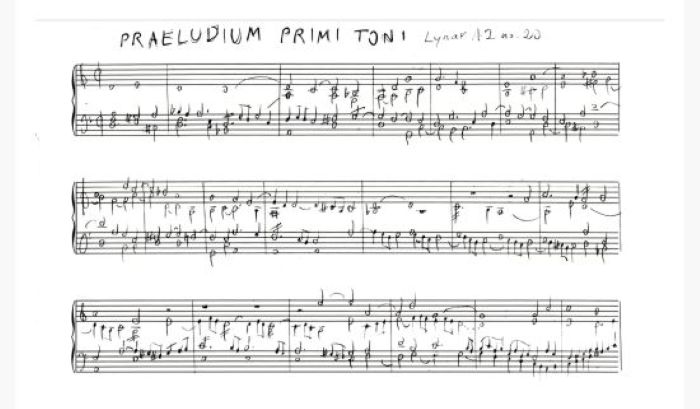
The second block is what concerns us here. It contains, rather surprisingly, two attributions to Tarquinio Merula (nos. 15 and 17), and other anonymous works which Alan Curtis rightly attributed on stylistic grounds to the same composer. In fact, Curtis only left out two pieces from the block. No. 20 is a Praeludium primi toni that Werner Breig thought “of too little importance to attempt an attribution to a specific composer”. I most emphatically disagree; the piece is a brilliant example of a prelude of north European provenance. Its use of double-stroke ornament signs puts it in the orbit of the Sweelinck school, and I think the Orpheus of Amsterdam himself would not have been ashamed to claim it. But its position as probable filler material at the bottom of pages 29 and 30, as well as its obviously anomalous origin, puts it outside the Merula block. I will return to the other piece not claimed for Merula by Curtis, no. 14 marked “Canzon”, in a moment.
Merula accepted an invitation to the Warsaw court of Sigismund III Vasa in 1621, and remained probably until 1625. The first documentation of his presence is found in an undated letter to the authorities in Danzig by Andreas Neunaber, requesting an extension of a study stipendium for Warsaw in order to profit from the presence there of Merula. It reads in part: “…I would not gladly leave here since there are so many excellent musicians, especially the Italian organist Tarquinium Meruli, who oftens visits my lord, Mr. Modlisefsky, Master of the Royal Kitchen, where I have a good opportunity to studieren. The final word is ambiguous; it can mean study, as from books – but I think in this case the high-ranking kitchen steward had a keyboard instrument available for practice, probably a clavichord.
Neunaber benefitted from his studies with Paul Siefert, the former Sweelinck student then employed at the Polish court, and probably from Merula as well, to such a degree that he later became one of the most prominent organists in the great Hanseatic city. Neunaber composed what is probably the earliest work to explicitly demand three manuals and pedal.
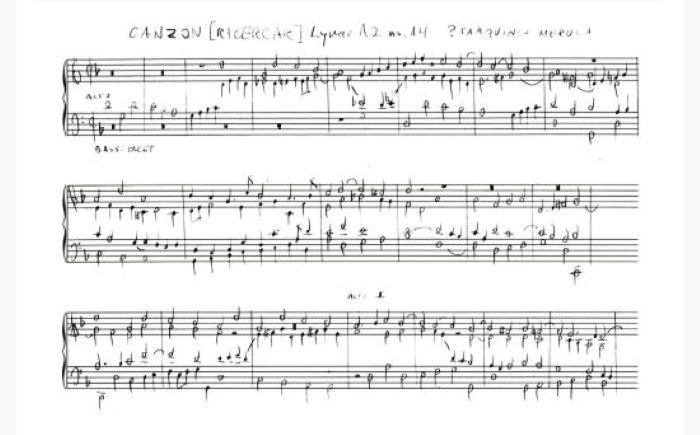
Breig agreed with Curtis that the theme and treatment of Canzon no. 14 were so different from the other three canzonas, all attributed to Merula, that it could not be by him. In fact, it looks much more like a ricercar than a canzona. And I would contend that it is, in fact, a ricercar – by Tarquinio Merula. To find a garbled title by the scribe of Lynar A1 and A2, one need look no farther than the next piece: a Tocato Secundi toni dell Signor Torquino Merula. This mangling of the Italian language and the composer’s name is such that a mistaken title – Canzon instead of Ricercar – looks comparatively innocuous.
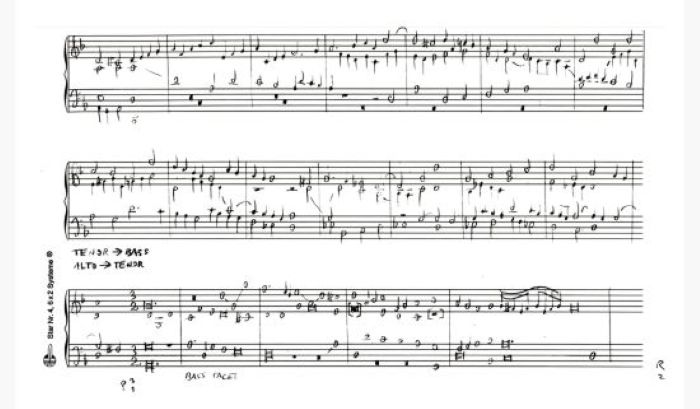
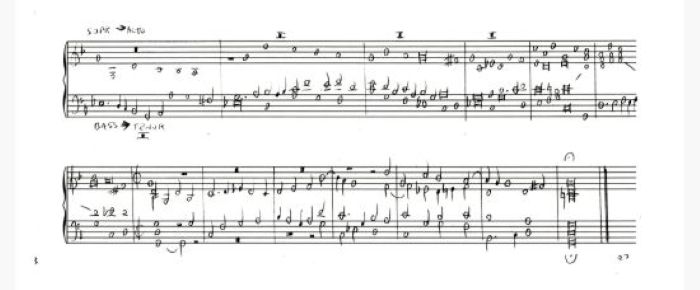
A close look at the piece confirms that it is indeed one of that most noble species of keyboard counterpoint, crystallized by Willaert in Musica Nova of 1540. One theme is casually treated, rectus and inversus. The composer-neighbors in Lynar A2, Erbach and G. Gabrieli, can be excluded on stylistic grounds. It looks quite unlike anything else by Merula…except we have nothing to compare it to. One feature, however, is very similar indeed: the section in triple time, which is treated precisely like those in the three canzonas. A casual approach to voice leading and dissonance add to the Italianate picture, as does division of hands between the staves. One spot requires a short octave.
The inclusion of no. 14 in this otherwise unified section of pieces by Merula is strong prima facie evidence, given nothing to the contrary, that it is his only surviving ricercar. Its warmth and ease radiate Italy. One wonders how the Poles and their Teutonic neighbors interacted with him. His appointment as “organist of church and chamber” to the turbulent Polish/Swedish despot came at an interval between Sigismund’s wars. Merula wasn’t the first to enjoy his patronage. No less a personage than Luca Marenzio had followed the court in its transition from Krakow to Warsaw in the 1590’s.
There must have been a considerable measure of pluralism present in Warsaw, as well as appreciation for merit, for a staunch Catholic like Sigismund III to have a Protestant from Danzig – an East Prussian city under Polish sovereignty – working in his capital. There had been a similar situation involving Byrd, Queen Elizabeth and James I prevailing in London when Paul Siefert was a young man.
The Praeludium no. 20 mentioned previously could be by Siefert. Actually, I think it is; and furthermore, I think he is the mysterious scribe of the two most important keyboard manuscripts of the early 17th century, Lynar A1 and A2. He was the eldest of Sweelinck’s students, going by age upon arrival in Amsterdam, giving him the maturity to understand how important it was to preserve the best of Jan Pietersz’ keyboard music. Siefert‘s vocal music is in the conservative style of his master, which got him into a pamphlet war with the Warsaw modernist Marco Scacchi. Siefert's connections to the southern Netherlands are documented by the Liber fratrum Cruciferorum Leodenensium of 1617, which contains a piece by him, and by the final section of Lynar A2. His connection to Dresden is shown by the Hintze manuscript at Yale, a Weckmann autograph which contains a small passacaglia “from Siefert’s book” by a young Danziger, Johann Balthasar Erben.** The choice of a passacaglia in Italian style gives rise to speculation about what that lost book of Siefert’s contained. Copies of the latest prints by Frescobaldi? Judging by style brisé courante of his, there was north-to-south influence as well.
Further to Siefert: the initials “M.W.” found at the end of Lynar A1 no. 70 famously led not only to an attribution to Matthias Weckmann, but to the since disproven theory that he was the scribe of A1. The two variations on “Lucidor einß hütt der schaf” are so obviously of the first-generation Sweelinck school that I think by the time he came into contact with its torchbearers, the day when a Matthias Weckmann would experiment with it was long past. This monogram is of a precision, accompanied by an elegant flourish, that suggests to me that it might mean “Meine Wenigkeit”. The idiom was already in use in German before our period. Finally, three anonymous toccatas near the end of A1 (nos. 75-7) look like attempts by Siefert or a lesser contemporary to imitate Sweelinck’s masterpieces in the genre. I was astounded to read in an article by Pieter Dirksen that he thinks the third of these clumsy efforts could be by Merula. (Even more astounding is his attribution of the final three suite movements in Lynar A1, an error-ridden late addition in a separate hand, to Froberger.)
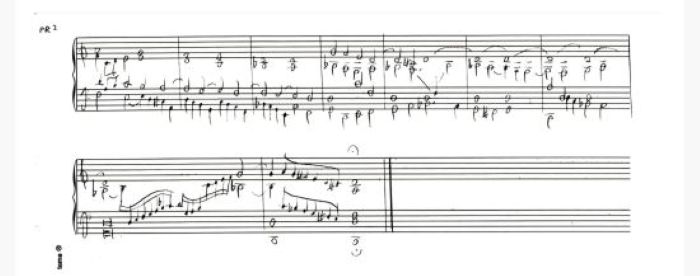
I offer a handmade transcription of the putative Merula ricercar and the Praeludium below. The originals keep the hands strictly divided and use the custos when a voice changes staff.
May Day 2026
*Two, nos. 3 and 6, are without specific attribution, but clearly belong to the Erbach block. The presence of so many works of his in the Lynar corpus has led scholars to think it must have originated in southern Germany. But there is an obvious link: the Schütz student Johann Klemm was sent to study with Erbach. When he returned to Dresden, he taught Weckmann, and edited works by Schütz. This puts Erbach, at least in a musical sense, in the circle Dresden-Hamburg-Danzig-Warsaw. He was of an age to be invited to the festive dedication of the organ at Schloss Gröningen, attended by 53 organists. But since, according to Werckmeister's list, his senior H. L. Hassler was there, the city might not have wanted both of their best musicians absent at the same time. Erbach is also present in force in ex-Berlin Staatsbibliothek Ms. 40316 (now in Krakow), a remarkable compilation including works by Frescobaldi, Sweelinck and Brussels organists.
**Erben is in all likelihood the “Pohlmann” (Pole) whom Weckmann was teaching from the pages of his own book. Erben’s further travels brought him to Regensburg, where he had dealings with Froberger, and to Würzburg. (On the way there from Nuremberg he will have passed by the location of my house on the Alte Landstraße.)
|